September 21, 2004 01:09 PM
Non-profit mission I
|
|
What's the most helpful thing workspot can do?
The people we want to help the most are people who cannot, or will not, own a computer. That's actually a majority of computer users, and a growing percentage, and yet the computing services available to them are rather limited & fragmented.
So the first mission is to create a free package, a distribution, of workspot's system, for use in community centers. Or anyplace with a one site, one room datacenter/Internet access lab.
Say you run a community center. You have an Internet connection, and a bunch of hand-me-down machines. First you put a self-configuring Linux installation CD into each of your machines. Then you put a special CD into each of the special-purpose machines:
firewalls
web servers
Internet service servers
file servers
backup servers
process servers
workstations
The workstations are what the people actually use in the Internet cafe. They have an account and using the Linux Terminal Server Project they share the resources at the community center. Using workspot they have web services & extranet services (all based on GPL packages) so they can both continue their work from anywhere, and broadcast to/interact with the outside world.
Essentially, the workspot distro is a modern version of a time-sharing system. In various forms, we think this is a wave of the future. It isn't clear that the personal-computer-ownership economy is quite working. Ever-bloating software on your personal computer eventually (sometimes rather soon) makes your machine obsolete or unusable. Unreliable software & hardware means you have to be a computer technician to reliably backup your work & data. And it is impossible to completely protect yourself from viruses. Really, experts need to do this work -- but only corporations can afford the software & personnel for a lightweight, well-maintained datacenter.
So, we want to provide a free datacenter package. A free network Computing package. Because we don't believe that large autocratic corporations should be the only ones with access to reliable computing!
|
|
September 25, 2003 01:03 AM
Who exactly?
|
|
So who exactly would this incipient GNU Workspot project be competing with? After all, to do the public good, it should become the standard GPL solution to specific problems in a diverse, expensive and messy market.
Citrix application deployment servers, for a start.
Sun has many related products: the Sun ONE identity server.
Portal server,
and the application server.
And Microsoft Terminal Services.
That's just for starters. And that's many thousands worth of software, soon to have free counterparts.
***
As with most categories with open source offerings, I think ours will not really effect commercial service providers -- there are always people and corporations that want to outsource, and it's not usually because of the price of software. Webex, Placewhere, Go-To-My-PC, Hotmail, Visto, VidiTel, and most ISP's will not be effected immediately by a free package allowing you to provide services to yourself. The cost of what they offer is closely tied to service, hardware and connectivity.
|
|
September 24, 2003 12:17 AM
Going non-profit
|
|
Generally, corporations make money through some form of mass-production, financed by investors, amplified by armies of salespeople, deal-makers, and support people.
Well, Workspot doesn't have any of that, and isn't likely to get it. And ... do we really want it? We're impoverished, as are many of our friends, so perhaps the unattainability of creating a corporate machine makes it easier to spurn the tools that have made capitalism the world's alpha-steamroller. But, on the other hand, we've been there, lived it, and really found it terrible.
So we'll be continuing this project as a non-profit endeavor, for the benefit of the software community. And shutting the for-profit corporation. This is no guarantee of success, but at least we won't be pretending to be a commercial venture any more. We have to get real: we have no assets, and we made almost no money this year.
Is going non-profit a bad thing? No. But how did we get here?
Well, no one is investing in innovation just now ... they are investing in 'scaling'. That is, if you're already successful, and have a high 'adoption rate', and don't really need investment, then you're likely to get a call any day now from someone with financing.
Secondly, no one is publicizing small projects. Everyone has a small project -- their blog, perhaps, or neat photos they snapped with their cellphone. So the media, which is very hungry itself, is looking for 'real' stories: 'hard' news with weight and pizazz. They're not generally looking to solve computing problems or improve the world. They're trying to get noticed, so people will read their websites.
So, no publicity for Workspot. We went public with the latest incarnation of our software in January, and there was a flurry of interest. But I couldn't get on News.com, or even Slashdot.
We've had some people look at us for possible investment: Google, Intel, etc. Generally, we're too far away from what's already happening, so the examination was keen but brief.
So this blog is about to morph into a rather different kind of beast: the log of an idealist, driven to create software that is useful for people, released under a GPL license, that will offer a free alternative to commodities from Citrix, HP, Sun, Microsoft, IBM, Oracle, etc. Does the software "compete" with theirs? "Undercut" theirs? Morally, that would be wonderful -- to me, these corporations help to squeeze the life out of the world, and out of their workers. I'd be overjoyed to accelerate the end of their days. But, more likely, I'm simply empowering a group who can't afford to be their customers. I'm interested in seeing software in the hands of any individual or small group who want to try to accomplish something good, or make a living, in a variety of ways I can't possibly imagine.
|
|
September 23, 2003 08:29 PM
A Word about AES & VNC
|
|
It hasn't been picked up by the media, but I think this is quite a story -- VNC now has the highly touted AES encryption standard, under GNU's GPL license.
Benny Soetarman of Workspot did this work, based on Dr Brian Gladman's algorithm.
The patches can be found here.
The encryption is self-contained, and lightweight, residing in the client and the server software itself. Benny explains:
"It doesn't use SSL. This is because of the Java client; it was too heavy to send the SSL classes or to have the users
install an SSL implementation. The new Java 1.4 already has SSL as part of the distribution, But the majority is using MSIE, and the JVM for it is pretty old. So the current AES implementation is self contained in the applet, linux
server, and native client."
|
|
Support problems
|
|
Thanks to everyone who was so patient with our support delays.
Basically, Workspot isn't making enough money to pay even a single person regularly, so whether or not your questions got answered depended on the availability of our core group members.
We've recently shuffled things around a bit, to provide better response. More shuffling to come!
|
|
July 30, 2003 12:58 AM
Network Applications
|
|
An obvious problem since the advent of browser-based applications -- the lack of an acceptable way to create true network applications -- something where the client-side could have a bit more juice than just HTML. Java applets were a glimpse in this direction -- but one of the reasons you don't see very many of them, is they just can't get very big without being unwieldy.
Macromedia Flash and the free SVG both address this problem too. Applications that download are another solution to the problem, but a difficult one, since it involves unique installation and update procedures for each application.
Frameworks, such as Microsoft's .NET and Sun's J2EE, are trying to address this problem with a comprehensive approach. Microsoft, with the largest installed user base, would seem poised to win the battle for the network application platform.
There's another potential contender: the Open Software Application Foundation's Chandler project. If this becomes a universal PIM, downloaded everywhere, taking parcels, with flexibility for user and application in storing information, then we have an application platform with some teeth.
So, now it's on our list: enable future Chandler users to synchronize data securely to their Workspot.
When they can't run Chandler natively, they can run it in a Workspot -- actually, you can do this now.
Chandler in a Workspot
|
|
July 18, 2003 12:31 PM
Looking for the showcase
|
|
The Linux economy needs a boost, and I think there's a way Workspot could provide it.
Imagine an Online Showcase, where you can try, rent, buy or download, any Linux desktop or server software, environment, distro or hardware ... directly supporting the developers.
It could be a retail site, but not being Amazon-inclined, I'd much prefer it to be a kind of 'consumer reports' come to life.
I'd love to set up an initial working version of the Online Showcase. But unfortunately we don't have the funding yet to do more than the service you see here.
VC's find us too small to fund. So we just have to continue to find subscribers, and slowly build out the showcase.
The free part of the showcase might look like this.
There'd be an equivalent ontology for logged-in Workspot users. They could also sign-up for the on-going focus group for an item they care about. They could evaluate changes online, in real time. The user could volunteer to have their session recorded for UI analysis. Programmers would have an audience. Users could vote on features and fixes. User-driven participatory democracy might create a real revolution in software!
|
|
June 08, 2003 12:27 AM
Web Playground
|
|
Workspot's Web Playground is back!
Workspot users get a website, http://users.workspot.net/~username, to fool around in. But it's the simplest web publishing imaginable: you just drop stuff into your public_html directory on your online Linux desktop. If you like, you can drop stuff into a webdav directory on your local machine, one that's linked to your public_html directory.
This was part of the original prototype, back before VNC was made GPL, and Workspot was a webtop.
After we quit working for SONY/Etak, every morning Curt Brune and I would meet at the University Coffee Café and try to think of the greatest thing we could do with an online desktop, with the least amount of work. This is actually one my fondest memories from the early days, because using this 'prioritized incremental approach', we made an amazing product in just a matter of days. And it was a refreshing breeze of freedom for for Curt Brune, a very inventive and lucid fellow, who had been trapped in corporate-change- control hell for years.
So, there were lots of cool possibilities, but editing your website from an online desktop had to be one of the coolest! And the coolest of the cool part was the cgi-bin subdirectory. Now, someone can just subscribe to workspot, go online, launch emacs in their browser (sic), and begin writing and using Perl to make generated web pages.
The obvious extension of this, is to offer more server applications and server environments for the users, so they can have a pre-configured server which they don't need to set up.
And an extension of that is to create an economy where people set up these turn-key server environments, and people pay to use them, or pay a subscription or micropayment to use the latest one. This could convert the "HOWTO" world in to the "DOIT" world ... why would you stop at a "how to" when you could make a working environment that a million programmers could use instantly?
One of the best Workspot legacies is that I published all these crazy ideas almost 5 years ago, so no one can possibly make a business plan patent based on it. Whew.
Your Workspot VNC session is now AES encrypted!
Another feature: the cross-platform clipboard! You can cut something from your PC, Mac or Linux desktop, and paste it to your Workspot. Go to another machine, and copy it from your Workspot desktop. Really useful and quick!
|
|
June 07, 2003 11:35 PM
Desktop 'viability'
|
|
Back at the dawn of the PC age, Pat Gelsinger & I used to push the internal use of Unix at Intel. [Somehow, Pat went on to be a serious player, and I went on to ... just play around, with serious intentions.]
In 1984, it was our opinion that the development of the 386 would be impossible without Unix. This was very important to us at the time. But it's been forgotten.
An operating system that supported the philosphy of sensible software tools, of increasing structural coherence, was abolutely critical for serious work. It is fairly accurate to say that Windows is not a serious operating system, and has always been driven by the wrong forces. Because of its evolution without a community-minded context, it is successful now in the marketplace, but will be forgotten in the long run.
I talked with Pat Gelsinger the other day, about Intel, and Unix's replacement, Linux.
Well, Intel loves Linux. He gave me some huge sales figure that Intel believes Linux is responsible for.
But, these are server sales. Internally, they don't see much of a chance for Linux on the desktop. "Operating system competition is definately in Intel's interest", he said. He's perfectly aware of Linux Desktop's technical advances, and traction outside of the consumer market. It's just not enough for Intel to invest in at the moment.
Well, Workspot is a personal web service, but it's also a demonstration of the Linux desktop.
So perception of the Linux desktop's viability is important to me.
But reality cannot be argued with: with the exception of the issue of stability (which is crazily underrated by people) Linux still is not the better OS (see below).
But this is just a matter of effort.
So I wrote Intel a little proposal cum manifesto. On how Workspot could help people make a better Linux. It's pretty bold:
Human comfort through public performance
Workspot is a remote Linux desktop service, used through a web
browser.
Workspot's goal is to become the online demonstration for all Linux projects and products. A showcase, in cyberspace.
The showcase offers two interesting opportunities:
- to ignite the Linux consumer desktop & application
economy
- to make Linux software the best in the industry
1. Workspot's existence means half-a-billion people can try a
Linux
desktop with one click. They can try it at length, by registering
for the
personal service. The struggling Linux economy could benefit hugely
from
facilitated sales, rentals, support services, and donations through
this
venue.
2. Workspot puts Linux directly in front of a live
audience.
It's an interactive experience. Suddenly, the possibilities become clear -- if these consumers could talk directly
with
the producers, the programmers, they would have the power to shape Linux in real-time, and to shape desktop
computing as never before. Workspot's goal is partly to create a diverse
test audience, and focus group; and partly to form a massive, coherent, fast-paced, participatory creative community.
Applications, window managers, features and bug fixes, could all
be
broadly consumer-tested, at the click of the button. No downloads,
no
configuration. We propose to partner with all Linux-related projects
and
help them to evolve under real-time public scrutiny. To facilitate
this, we
must give the public unprecedented influence:
- to comment
- to rate all parts of the experience
- to make requests
- to set priorities
- to contribute ideas and solutions
- to elucidate successful patterns
- to build a community memory
- to pay for improvements
- to reward responsiveness
... in a continuous (daily, at a minimum) cycle of change.
Projects
will naturally borrow solutions from each other, converging and
diverging
into distinct products: methodically, smoothly, and quickly. Users
vote with
their Workspot account, and put money towards the features and
qualities
they want implemented or modified.
Everyday, consumers indirectly influence the shape of web operations and network applications. We will give birth to a more direct
form
of this influence; and for the first time, point it towards the
application and desktop world.
|
|
March 31, 2003 10:24 PM
Distractions
|
|
I remember, in Palo Alto during the Internet boom, everything was so intense, everyone could sense the historical forces, the people, and the money at work ... "it feels like a war," I quipped, "just massive birth instead of massive death."
But the only similarity I see now, between war and boom, is that I've become an Internet news junkie again. And a vertebra in my neck is hurting once more. The differences are more striking. For example, the difference between "Internet Time", as we first perceived it, and now.
Just try to watch how quickly important stories move around today ... it's enough to give you whiplash. Ah, perhaps that explains my neck pain.
I followed the Peter Arnett thing today ... he went from working for NBC and National Geographic, to the Daily Mirror, in an instant.
But even more amazing is how fast history can be rewritten. Arnett's Baghdad stories disappeared from NBC. I saw the entries in the search database, but they clicked through to nowhere.
|
|
March 16, 2003 10:41 PM
Speed
|
|
Just got a note from Dan Gillmor, saying that he found Workspot bogglingly slow.
On the other hand, a real-time data guru, John Sahr, who uses the passive radar of commercial FM broadcasts to monitor the shape of the earth's ionosphere, says: "I logged in using Netscape on a RH7.3 laptop over a 384k DSL link, performance was amazingly good, considering what was happening. It was obviously slower than a "regular" link, but definitely fast enough to use. "
It's a good thing we have the demo, so people can self-select for speed! I wrote Dan that he may have a constrained connection, but "performance perception is a delicate issue ... it's possible that our subscribers tend to be intrigued by latency, rather than suffer from it ... "
|
|
March 15, 2003 04:08 PM
Lug
|
|
During a raging anti-war party in downtown Eugene, a small group of shy technology people held a monthly Eugene Linux user's group meeting. Like all Eugene groups, the meeting was replete with characters far too complex to invent. This may be one of the few cities whose non-profit free software group, efn.org, has a storefront in the city's center. I'm tempted to open a workspot.org shop next to it.
The topic of the meeting: Knoppix, the Linux Terminal Server Project, and Workspot. Knoppix works extremely well, although it still helps to be a Linux admin, depending on what you need to do with it. LTSP is used for the Internet café at efn.org.
Bob Miller organized a working core group for the demo, with laptops and several extra machines and pieces of equipment. The group pieced together and debugged the demo in front of a live audience (albeit a small one). Like a live engineering project, Bob acting a the chief engineer. Actually much more interesting than trying to 'produce' a slick, foolproof demo. The process is as educational as the product.
From a dozen people, only one person was really interested in proselytizing the Linux desktop. He was only partly satisfied with Knoppix -- it's great, but still rather install-like. He was about to leave before the Workspot demo: I stopped him, and asked Bob to launch a browser on Knoppix, which I'd never done before, and go to workspot.com. Mozilla came up, luckily with Java pre-installed, and I said 'hit the button'! Voila, the desktop appears! With enough attention to robustness, sometimes things will work in the worst of circumstances.
|
|
March 13, 2003 04:10 AM
The simple reason
|
|
Late night talk with Christopher Alexander ... I mention the one-click Linux demo. He says that should be a very big deal, to Linux people. I said it should be a big deal to half-a-billion people.
He looks at me with his 'be honest' look and says "Is Linux the best desktop?" I say, no, Mac OS X and Windows XP are still better in several ways, although no desktop is really going in a good overall direction. He said "you're not being a very good salesman. What's the point in showing people a Linux desktop that's not better than what they have?"
He said that the $100 cost of an operating system, amortized over the life of the machine, is very little money. I said that for big purchases by corporations and governments, it makes a difference. "Is that your market? Bureaucrats?"
No, certainly Workspot's for individuals. And individuals usually choose for themselves. So they need to see something better. Linux is popular among people who can use its strengths. Either people need to grow to be more Linux-like (which isn't too common, but it's kind of the goal of many LUGS); or, Linux has to work better for people. When it does, then we'll build real momentum on the desktop.
So, we must make a better desktop.
|
|
March 07, 2003 11:09 AM
Manifest immortality
|
|
You know, about a week ago, I started to write a wild manifesto
for Internet corporations -- about the need for openness and
honesty; about gathering customers and partners by having
good intentions and making them visible; about resisting the
temptation to spin PR fantasies, and instead helping to reveal
what really goes on in the world; about effective companies
without the trappings of corporate offices; about working
with your heart on your sleeve, instead of hiding behind the
badge and business card of sterile professionalism; about
the desperate need to move capital and commerce towards truly
public-minded, sustainable, humane, personal and meaningful
work ...
... and then I started my blog, and such ranting seemed redundant.
In the next week, I'll try to get other CEOs to blog. It's
not hard: certainly they write enough office memos! It's about
time they wrote memos to their public ...
***
Chris Gulker
just publicly shared a moment of his
enthusiasm as a Workspot user. He's a legitimate fan ...
all his correspondence to me comes from his workspot.net e-mail
address [using Ximian in a browser beats webmail anyday.]
If you Google Gulker, you find out about his
secret past as a high-end Hollywood paparazzi. I like his
photo of Brooke
Shields. [He's now putting all his photos online! Excellent! He's photographed everyone: Gore Vidal, Lisa Lyons ... he even caught me in my old haunt in Palo Alto.]
***
Chris Gulker quoted me anonymously during the
dotcom boom, when I described Workspot as fulfilling yet another
computing dream: the
immortal machine ...
What kind of dream is that? Here's a sample
motivation for 'immortality':
Up until the mid-1990's, architect Christopher
Alexander was happily using software under a long discarded
DOS-based graphics system known as GEM.
He was really fond of the software, it was simple and elegant
for writing books, and honestly, he produced excellent work
with it. "Why on earth would I stop using this?"
he asked me.
Because of ... lots of bad reasons, basically.
It was getting harder to incorporate the format into any other
document, to translate it, to print it, to e-mail it ... etc.
Everyone has a similar experience ... forced to abandon something
good for something contemporary.
This isn't right! Lots of old software is wonderful!
Thousands of projects on the web are dedicated to good old
software. In fact, the obsession with Linux owes a huge debt
to the resonance of the original brilliant papers on software
tools, which came out of Bell Labs some 30 years ago.
Immortal machines? I have lots of old code,
which I'd release under GPL, and start a project around ...
if it only ran on something! FreeDOS,
OpenVMS, BSD & Linux
will make that possible in theory ...
... but on a practical basis, once something
runs, I want it to continue to run! Is that asking
so much? I know the reasons ... techno-cultural shifts, or
whatever they're called at the moment.
But we have the opportunity now to fix this
situation. We could keep these environments running on Workspot
forever, for people to use whenever they need it.
A fellow wrote me from a Portland company, saying
he'd like to put his software up on Workspot, to demo to some
colleagues, but it only runs on RedHat 7.3 at the moment.
Early this year, we updated all our machines to RH 8.0. So,
although we have a better system, our immortal machine is
already suffering bit-rot.
Virtual machines (see Thursday) can take care
of that problem ... once they're up, probably in the summer,
we'll just keep lots of Linux distros around ... we'll
keep around as many versions as we can, and make sure
they work. (We couldn't do that with Windows ...)
Most importantly, when we arrange old software
in a showcase, and attach it to micropayments,
programmers could be paid to support good, existing
application software. Today, the typical software business
model is: release worse software, with new addictive additives,
as often as possible!
***
I'll long-jump past the boundary of bleeding-edge
here, and say that an immortal machine needs more than versions
of operating environments. It need to save running
systems ...
If I have a desktop with a dozen windows open
(or emacs with two dozen buffers) it's because I'm working
on some specific thing, and I need programs, manuals and massive
context. I want to take all that, and store it, for a
year if I have to. I want to be able to revive it,
to pass it on to someone else ... I want it to be a memory
aid.
If this sounds like going overboard to be user
friendly, look into the field of process migration.
Many groups like this
are freezing the state of an entire system.
This doesn't just let you leave a cluttered
desktop for later ... it lets you clone a cluttered
desktop so you can give it to someone else to use; it lets
you show someone an unfolding, evolving system ...
... and it lets you checkpoint your work
when it's in a good state, so you can experiment,
screw it up and still go back to where it was working
last! This is really critical for learning how to do
good work ... it's hard to learn to draw properly without
an eraser! [That may sound glib, but you can get into terrible
habits if you teach yourself to draw, from life, with only
a pen. I have a whole
site of drawings serving witness to this!]
Because of the existence for decades of version
systems, like CVS, many
computer people realize this ...
But I remember a mutual-enthusiasm session
I had with Will
Wright last year, where we explained this exact thing
to each other, in the context of Chris Alexander's generative
sequences. We imagined a vast network of instruction,
much like A Pattern
Language, which users would navigate in order to build
things. And then Chris came in, and we explained what we were
talking about, and the cleverness of our infinite back-tracking
idea, and he said, basically, that if you learn to work deeply,
and "if a sequence is really good, then you won't
have to correct much". Infinite support for user mistakes
could lead to infinitely shallow users.
***
Originally, Workspot was interested in process
migration so we could send a user's work to a nearby datacenter,
to cut down on latency. This caused our crypto-colleague Efrem
Lipkin [whose early work is chronicled in Steven
Levy's book Hackers] to go into a hilarious and
profound meditation, for weeks, on the subject of process
migration to untrusted servers. Can you keep a process
encrypted as it's running? Think about it.
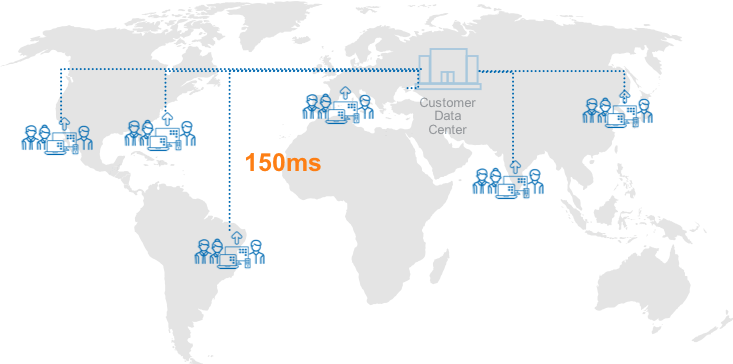
But it turned out to be moot. Most of Workspot's
latency develops in traveling the last mile, not the thousands
of miles along the backbone. It works fine in Japan.
|
|
March 06, 2003 05:13 PM
Dreams of virtual machines ...
|
|
A simple thing, which people can't yet do with their Workspot,
is install a program as root.
Another simple thing, which I want, is for people
to run freshly contributed software on Workspot. Let's say
that 'mad genius X' has just written a program that will change
everything ... people should be able to run such freshmeat
without installing it on their home machine.
But we can't yet set up a system where we encourage everyone
to distribute standalone programs, and run them. If someone
offers you an executable in their directory, it could plant
something nasty in your directory, the moment you use
it.
All this implies disposable machines: virtual machines
on which you could install anything as root; and virtual machines
(with a virtual filesystem, or journalling and rollback) on
which you could run anything as a normal user.
Programs could go through the normal community acceptance
promotions, until they were tested, read and trusted enough
to run at home.
[Someday, of course, all home machines, which will run Linux,
should have these features and handle these issues automatically].
When I started working on Workspot, in 1998, it was obvious
that we'd have to tackle virtual machines. Bruce Robertson
started writing a VM Manager, and watching the progress of
other projects, even proprietary ones like VMWare (something
we were wary of, because we'd have to change it so much).
A founder of VMWare visited us in Palo Alto ... but nothing
happened before the bubble burst.
A number of GPL VM initiatives that have emerged (I recommend
Grant Gross's Newsforge summary):
The technical issues are interesting. At the moment our VNC
server spawns sessions on a cluster of machines -- we'd either
need it to spawn a session within a VM, or direct the user
to remote login to that VM from their main Workspot desktop.
The same choice applies to starting a fresh VM.
But which makes more sense from a user standpoint? There
are many scenarios where we'll need to spawn a VM without
initiating a desktop -- for example, when we run a single
application in a web page ... (I'll write about this, Appspot,
soon.) So we need to create HTML navigation through the Software
Showcase anyway.
But someday, especially since we are desktop Linux
advocates, we'll need to create a desktop interface to all
this variety. Luckily, we have Nautilus, and it should be
satisfactory to use directories to navigate, through all the
possible machines and distros, cooked and raw software.
The main issue with the raw software is protecting the user's
files. Since our first time around, journaling filesystems,
which keep a transaction journal of filesystem writes, and
allow you to rollback in case of trouble, have become more
cooked. I'll write about these soon.
Hey, with virtual machines running, we'll be able to demonstrate
the different kinds of Linux filesystems too! And work on
sensible, humane user interfaces to filesystem rollback! One
step at a time ...
|
|
March 05, 2003 11:03 PM
Showcasing
|
|
We're in banner
rotation at DesktopLinux.com,
as part of our referral program.
The best part
of partnering with these folks, is that they'll help me fulfill
some computing dreams.
Workspot should
be a Showcase in Cyberspace (catchy? kitschy?) for
all Linux software and hardware.
The
very existence of this showcase should improve
what's produced. I'd like the software to change in quick
cycles, in front of people's eyes ... programming as performance
art!
This is a pretty
tall order, but we should be able to organize it by the summer.
With everyone watching and helping, improbable things still
happen in Internet time!
All of these vendors and projects, large and small, need
money. One of the things we'll have is a micropayment
system -- software rental for pennies.
Imagine you need to use some crazy specialized high-end workstation
application. Today, you can't usually try it without contacting
a salesman. So most people won't try it! That's no good for
anyone.
But what if you could try it for a few cents, and then compare
it to the competition, for a few cents more? To me, this meets
a straightforward consumer need, to test drive and sample,
to see the breadth of possibilities. It's like a real marketplace;
a tangible Consumer Guide. Users can sample for as long as
they want -- they're being charged as they go. Vendors get
money, feedback, and a growing client base. Everyone wins.
It's amazing to me that this isn't available yet. I mentioned
it publicly years ago, and still it hasn't happened. We'll
do it here, and we'll do it first for Free Software.
There's hardware I'd like to see too ... I think many people
would like to testdrive servers from Sun, HP and IBM. Embedded
chip emulators could be very useful. And why not a small Beowulf
cluster? ... or Deep Blue Jr. ? Or film rendering engines?
Supercomputing for the masses!
*
Jeremy White, who founded the Wine-leveraging
company CodeWeavers,
is interim chair of the Desktop
Linux Consortium. He's put me on the advisory board. Heh
heh ... GNU/Linux will push Microsoft off the desktop, blotter
and all. It's inevitable.
|
|
March 04, 2003 11:57 PM
Cross reference
|
|
Dear diary, so much happened today.
The demo's up! Anyone in the world with an Internet connection
can now try a GNU/Linux desktop instantly -- with two
clicks (including this one)! Ha! Another first!
Oops, I should've make it one-click! Some advocate
for humans I am!
Hey, one-click Linux -- that would be another first! (Yawn).
What the heck, let's do it:
I guess I'm still shy from when the Amazon patent for one-click
purchase came through. We were doing the Palm wireless
app for Barnes & Noble, and the court order came down,
and B&N had to change everything on their site immediately
... I don't know exactly what happened, but Curt wandered
over to me, shaking his head, and said the frantic bn.com
chief engineer just disgorged the entire system's code at
him, "Here! Figure it out yourself!"
Speaking of Amazon patents, we have a referral program in
place, redolent of this Amazon patent: "an Internet-based
referral system that enables individuals and other business
entities ('associates') to market products, in return for
a commission, that are sold from a merchant's website".
I'm not the only one that finds it incredible that
they received a patent on reselling over the Internet.
Why not just patent capitalism? Or conspicuous consumption?
Then everyone would have a good excuse to get out of the rat
race.
Well, we need to do this referral program anyway. Perhaps
someone at KP will invest ten dollars in Workspot, so we don't
get a court order? No. That's the coward's way out ... instead,
I want every Linux site to do Workspot referrals ... they'll
make money this way (and they need it!) and if Amazon's lawyers
call, the riot will shake the Internet to its roots, and we
can organize a massive overthrow of all this nonsense.
Our first two referral volunteers to face the lawyers:
... the weblog of Chris Gulker.
He writes for one of my favorite British papers, The
Independent.
... and Bruce Sterling's Viridian
Design site: a Green celebration of the end of post-modernism.
(I need to get him to read The
Nature of Order ...oh -- Bruce: "Yeah, Chris Alexander,
he's an interesting guy. My architect made us read PATTERN
LANGUAGE before building this house that I'm sitting in.")
Another hot story: our VNC
applet now tells you what ports it's trying to use to connect
to the Linux desktop. Cool. Could even be a diagnostic tool.
When we're sure it's working well, the code changes will go
on workspot.org.
|
|
Grand opening
|
|
Had a great talk
with Jill, the desktop dynamo from DesktopLinux.com.
With the energy of people like her, in five years nobody will
be using Microsoft on the desktop. [Oops! I hope I didn't
just put her life in danger!]
I want to quote
from my original letter to her:
"There are perhaps a half billion people, with Internet
connections, who don't run Linux on their desktop. The point
of DesktopLinux.com, as it comes across to me, is to (1) convert
these masses and (2) organize the revolutionary
working group.
These goals also drive Workspot. It's a GNU/Linux desktop
demonstration, for anyone with an Internet connection.
And it's a place where a specific desktop can be used and
seen simultaneously by many people. With pre-installed
examples, it can facilitate discussion of the human qualities
of features and applications. It can speed up and broaden
the adoption of good structure and function. It could be a
platform where developers get instant feedback from a large
audience ...
I know it can do these things, because we do it everyday.
Our happy users grab our attention daily, and on a daily
basis, we fix things, and move to the next issue. This is
the way desktops should be improved, using a quick&small
cycle, an incremental approach, uncovering the largest problems
with an active test group.
This is the strength of the Internet community, and yet it's
barely tapped in the application and desktop platform world.
Workspot offers this. All I need is community agreement:
that Linux needs an online demo. "
|
|
Introduction
|
|
I've always said
that Workspot is an open corporation. But where's the proof?
Does any
tech ceo do a blog yet? (Besides Dave
Winer, of course). Please write me and right me, if I'm
wrong. I know Alan
Meckler is trying this, but he's more of a media guy.
I'm pure geek.
Secrecy gets you
nowhere in life. People who hide ideas tend to stop having
them. I think Jerry
Weinberg wrote something like that. [Even if you give
away ideas as fast as he does, you should still be cited,
when possible.]
In business, the
hardest thing, and the most important thing, is mingling
with the real world. So secrecy only hurts. Customers and
partners and employees and friends all benefit from openness
and transparency. If everyone really knows what you're doing:
potential competitors can become partners; potential victims
can stop you; mutual support can flourish. Competition? Sheesh.
The purpose of business should be to make the world
better, so there's plenty of work to go around!
But, of course,
beware: a blog like this only makes it seem like I'm
telling you everything.
Years ago, I think
I was with Jay Walljasper at Utne
Reader's magazine-rack-centered offices in Minneapolis,
and we started talking about those "Correction"
columns in newspapers. And how such a column implies that
everything in the paper is true, that they left no stone unturned,
except for a few minor oversights! [Chomsky
or Cockburn probably
pointed this out first].
But even if I'm
honest and thorough, a blog like this can only offer glimpses.
I can't show the whole. Well, I can try. Ok,
I won't try, I'll do it. [Hm. No. I'll avoid
the Yoda citation.]
|
|
e-mail: greg at workspot dot
com
XML
|
|